
Arrivals + Departures
Wednesday 5 May 2021
Artists Yara and Davina create ambitious public artworks that respond to site, context and audience. Their inventive, issue-based work is wide ranging, and uses a lightness of touch that make their works both poetic and universal.
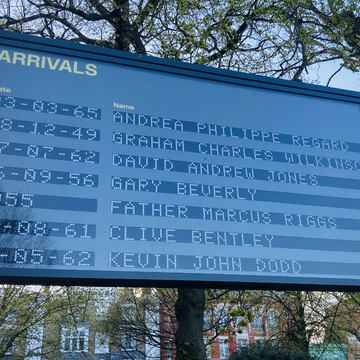
Arrivals + Departures invites the public to share the names of those who have arrived and departed on live boards, to acknowledge, celebrate and commemorate.
On Wednesday 5 May 2021 Yara and Davina invited me to ‘takeover’ the boards of their Brighton International Festival exhibit in Pavilion Gardens to commemorate the lives of those who died from an AIDS-related illness in Brighton & Hove.
It was an honour & a pleasure to be invited to be a part of this wonderful public artwork exploring birth, death, and the journey in between.
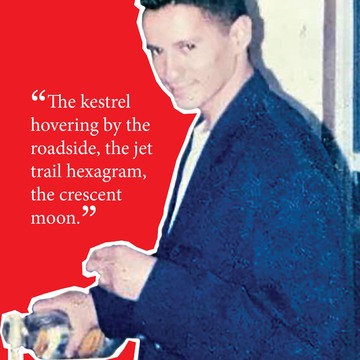
‘In the roaring waters,
I hear the voices of dead friends
Love is life that lasts forever
My hearts memory turns to you...’
Andrea Philippe Regard
Arrival - 16 March 1965 / Departure - 13 May 1991
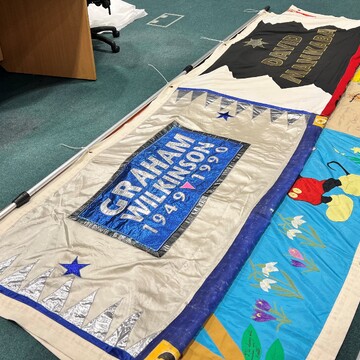
Graham Charles Wilkinson
Arrival - 08 December 1949 / Died 22 August 1990 (London Lighthouse)
David Andrew Jones ‘Cooch’
Arrival - 17 July 1962 / Departure - 18 October 1999
Gary Beverly
Arrival - 26 September 1956 / Departure - 23 June 1993
Father Marcus Riggs
Arrival -1955 / Departure - 10 July 1998
Clive Bentley
Arrival - 07 August 1961 / Departure - 17 August 1994
Kevin John Dodd
Arrival - 21 May 1962 / Departure - February 1992
The quoted text comes from the film ‘Blue’ by Derek Jarman.
Arthur Law’s Star Quilt is seen here on the start of the Brighton Lesbian and Gay Pride march in 1992. Arthur was one of the Pink Parasol committee responsible for organising the event. As well as being a fearless and committed activist, Arthur was a brilliant designer and a gifted sewer. He also made the Fighting AIDS Brighton banner for Our House Body Positive, which can be seen here displayed on Queens Park railings at the Pink Picnic in 1993.
Arthur died on the 17 May 2018
Thanks to Avee Isofa Holmes & www.wildbloodandqueenie.com for use of the images
Clive Bentley
7 August 1961 - 17 August 1994
Clive’s Brighton life began at Sussex University when he started an Environmental Science degree in 1979. After this, he embarked on training as an accountant and thanks to a fascination for detail and his meticulous approach; he was set for a successful career.
Testing HIV positive started Clive on a journey of personal discovery which would influence the rest of his life and everyone who knew him. At a time when fear and hostility surrounding HIV were at their most hysterical, Clive made the decision to confront his diagnosis head-on. He was deeply committed to understanding the virus and helping others do the same. Along with getting to grips with the mechanics of the disease, Clive invested huge amounts of energy exploring the personal impact of HIV on his life and others. For Clive, who co-founded Body Positive with Graham Wilkinson in 1985, and then became Sussex AIDS Centre & Helpline’s first administrator in 1986, his work was never just a job.
Clive was never simply motivated by his own struggle. He was a committed socialist, enraged by all forms of inequality and discrimination. Where his brain held knowledge, his heart was always in touch with the human consequences of treating others as outsiders. Clive also had a great sense of humour and a tremendous wit which was a release from the collective pain of HIV and a way of bringing people together in the face of it.
Not only was Clive a highly efficient administrator but also a skilled trainer and group worker, and when he was able, he loved to travel and experience other cultures, especially Italy and Italian food. Clive made a huge impact on the lives of those who knew him and loved him, but also on those who only met him briefly. He was a unique and special individual and those who met him were different because of the experience. It’s in that difference that we have a permanent reminder of his too brief but explosive presence among us.
Graham Charles Wilkinson
Graham Charles Wilkinson was one of small group of gay men in London who shared a vision for innovative new centres for people living with HIV in the UK. The group started to meet and talk about their ideas at the flat of Christopher Spence OBE, who’d later become director of the Lighthouse in Ladbroke Grove when it opened in 1986.
Graham was acutely aware that Brighton was desperate for services to help the growing numbers affected by the epidemic, so he set to work bringing the vision to the coast. Determined and courageous, Graham decided to quit his job to found the Sussex AIDS Helpline in a ‘grotty’ little office on Brighton’s Western Road in October 1987. In the early days, the helpline was a very hands-on affair with Graham and a few friends answering all the calls, but despite its humble beginnings, it soon became essential for anyone needing good advice, compassion and the facts.
By all accounts Graham was a shy man who found the constant battles, resistance and stigma of the times hard to manage against the backdrop of his own illness. Sometimes the stress of the situation would get the better of him, but before long the light would appear in his face alongside an infectious giggle that anyone who knew him will never forget. By all accounts, Graham was a loving and supportive man who could be relied on to give someone a cuddle.
Graham lived on Devonshire Place in Kemptown with his partner and playwright John Roman Baker at the time. They used their flat as a centre for the fundraising and lobbying which helped Graham to realise his vision when the Sussex AIDS Centre and Helpline opened at 3 Cavendish Street in 1988. Despite his poor health Graham played a key role in shaping, influencing and establishing the HIV services in Brighton which continue today, and his tireless commitment served to directly impact and improve the quality of lives of countless people living with HIV in Brighton.
Graham ended his days at the London Lighthouse on 22 August 1990 surrounded by friends. His service was held in St Peters Church with standing room only - a testimony to the love and respect that existed for him in the city. - Danny West - 2021
22 August 2021
This evening, John and I are listening to Donna Summer and remembering Graham Wilkinson who died this day 31 years ago at London Lighthouse (at the time there was no hospice for people with HIV/Aids in Brighton).
He was a tireless gay rights campaigner from the 1970s onwards and then in the 1980s fought tooth and nail as co-founder and director of the Sussex Aids Centre & Helpline (now THT South). His work, spirit and achievements should not be forgotten.
It was a time when gay men in particular, but also others with HIV, were collateral damage in a deeply Conservative society where sadly even within our own community we had to fight self-hatred while the government held out for a feared heterosexual epidemic which of course (thankfully) did not materialise.
Graham inspired and touched the lives of so many, but to John and myself he was so much more. He was our family and is deeply missed. Words by Rod Evan & John Roman Baker
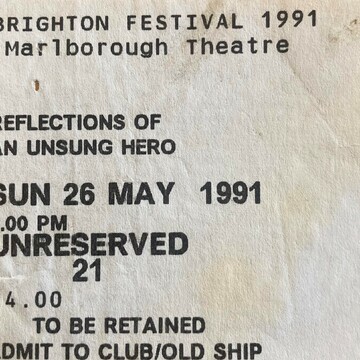
Reflections of an Unsung Hero
Reflections of an Unsung Hero was a solo performance created by Robert Pacitti, directed by Colin Schantz and commissioned by Aputheatre (AIDS Positive Underground Theatre Company) to cherish the work of Graham Wilkinson.
Playwright John Roman Baker was so impressed by Robert’s performance of ‘Lust’ during his second year at Art School in 1990, that he approached him to create a performance to honour Graham, and gave him full copies of Graham’s diaries to work with. The commission asked for a radical live performance that responded to the content of the diaries, Graham’s Gay Liberation Front and extensive AIDS activism, and his significant lifetime legacy fighting for change.
Because Graham had lost his sight, Robert wore an eye mask and travelled around Brighton on the bus to immerse himself in the role. The play was rehearsed at the Sussex AIDS Centre and Helpline in readiness for the 1991 Brighton Festival, but was nearly de-railed when Gavin Henderson, the Brighton Festival director, pulled the play from the programme due to its subject matter and the theatre company name. Lindsey Kemp was one of the festival headliners that year, and when news reached him that the play had been removed from the programme, Robert was asked to meet at his hotel. When Lindsey heard the full story, he gave Robert £500 in cash so that the play could go ahead, and had it reinstated in the festival programme.
The play was performed at the Marlborough Theatre on the 26 May 1991.
Sussex AIDS Centre
“We held the first Brighton and Hove public meeting on AIDS in 1984 at offices in Lansdowne Place, Hove. Graham Wilkinson and I split the small cost of hiring the room and invited someone from the recently formed THT to come along and explain what they were doing in London. Both Graham and I had joined THTs small Social Work group which met at their original tiny offices in London – at that time only consisting of a couple of rooms. So, it was at this first public meeting that a handful of us volunteered to set up the Sussex AIDS Helpline.
We knew the person who at the time managed the Well-Women Clinic above a shop on the corner of Western Road and Waterloo Street in Hove. They very kindly agreed to let us use their offices in the evening when they were closed and allowed us to use a telephone line for free.
Graham and I both worked together as Social Workers in the Hanover Team based opposite St Peters Church, and we managed to get permission to use our offices in the evening for training and support groups. As professional social workers we were able to put together a training programme for the early volunteers to help handle phone calls. Graham or I would either take the calls ourselves, or be there as support for the other volunteers.
For the first 2 years Sussex AIDS Helpline got no official funding. We managed to get by with volunteer time and effort, meeting in each other’s homes, raising awareness in pubs and clubs, and by borrowing facilities and resources from the Well Women's Clinic and Social Services Hanover Team. A couple of years later we became the Sussex AIDS Centre and Helpline.”
Clive Stevens
The Brighton AIDS Memorial Exhibition was displayed at the Dorset Gardens Methodist Church and the Ledward Centre on Jubilee Street between the 24th November and the 4th December 2021
'Love is life that lasts forever'
To mark World AIDS Day 2023, the Brighton AIDS Memorial was proud to display two Brighton specific panels on loan from the UK AIDS Memorial Quilt collection. This was made possible with the generous support of the LGBTQ Workers Forum.
The panels which were both sewn in 1991, had not been seen on display in the city for over 30 years.
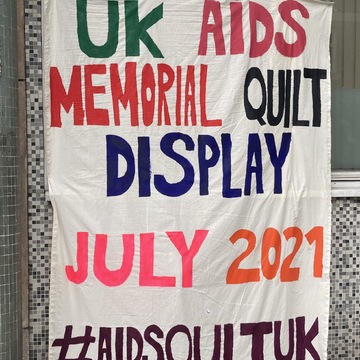
UK AIDS Memorial Exhibition at Acorn House, London - dedicated to the lives of all those who lost their lives to HIV in the 40 years since the HIV pandemic began, and to all who loved them. We will always remember them.